messaging platform graveyard
The Messaging Platform Graveyard: Why Team Chat Products Die
Workplace, Campsite, Threads.com—and what their endings teach Slack-alternative buyers in the agent era.

By Ando
5 min read · Last updated October 6, 2026
The messaging platform graveyard shows why many Slack alternatives struggled to survive: switching costs, network effects, and unclear reasons to move a whole team. The history is useful when judging whether a new messenger solves a durable collaboration problem.
Team chat looks inevitable until it isn’t.
Every few years a thoughtful Slack alternative earns a devoted following—calmer feeds, better posts, fairer pricing, open source purity—and then the blog post arrives: wind-down, acquisition, “focusing on AI,” preferred migration partner. The work conversations still have to live somewhere. Usually they migrate back to Slack or Teams.
This is a graveyard tour with a purpose. Not schadenfreude. Pattern recognition for anyone evaluating Slack alternatives in 2026, including agent-native ones like Ando. If you’re building or buying the next messenger, the dead teach clearer lessons than the living.
Naming note: This is about workplace / team messaging—not Instagram’s consumer Threads app (shut down 2021 as a Close Friends companion), and not Meta’s later consumer social product also called Threads. Where we mention Threads.com, we mean the Sequoia-backed Slack alternative later acquired by Shopify.
Headstones (verified)
Workplace from Meta (2016 → decommissioned 2026)
Meta’s enterprise social / work communications product—Facebook’s grammar for companies. In May 2024 Meta announced it would discontinue Workplace to focus on AI and metaverse technologies, pointing customers to Zoom’s Workvivo as preferred migration partner (Reuters, TechCrunch). Timeline reported across coverage: normal use into Aug 31, 2025; read-only into May 2026; deletion around June 2026.
Lesson: Even a hyperscaler distribution advantage doesn’t guarantee a durable #2 against Slack + Teams. When the parent’s strategy shifts, customer chat becomes a migration project.
Careful correction: Meta did not tell Workplace customers “go to Slack.” Separately, in Sep 2026, Business Insider reported Meta moving internal communications from Google Chat to Slack because leadership believed Slack was stronger for AI agents. That’s an internal tool choice—not the Workplace customer off-ramp.
Campsite (wound down Feb 28, 2025)
A calm, post-centric collaboration tool many people loved as a Slack alternative. Co-founder Brian Lovin announced Campsite would wind down February 28, 2025, with founders joining Notion and a data exporter for public-channel posts/comments (Campsite wind-down post).
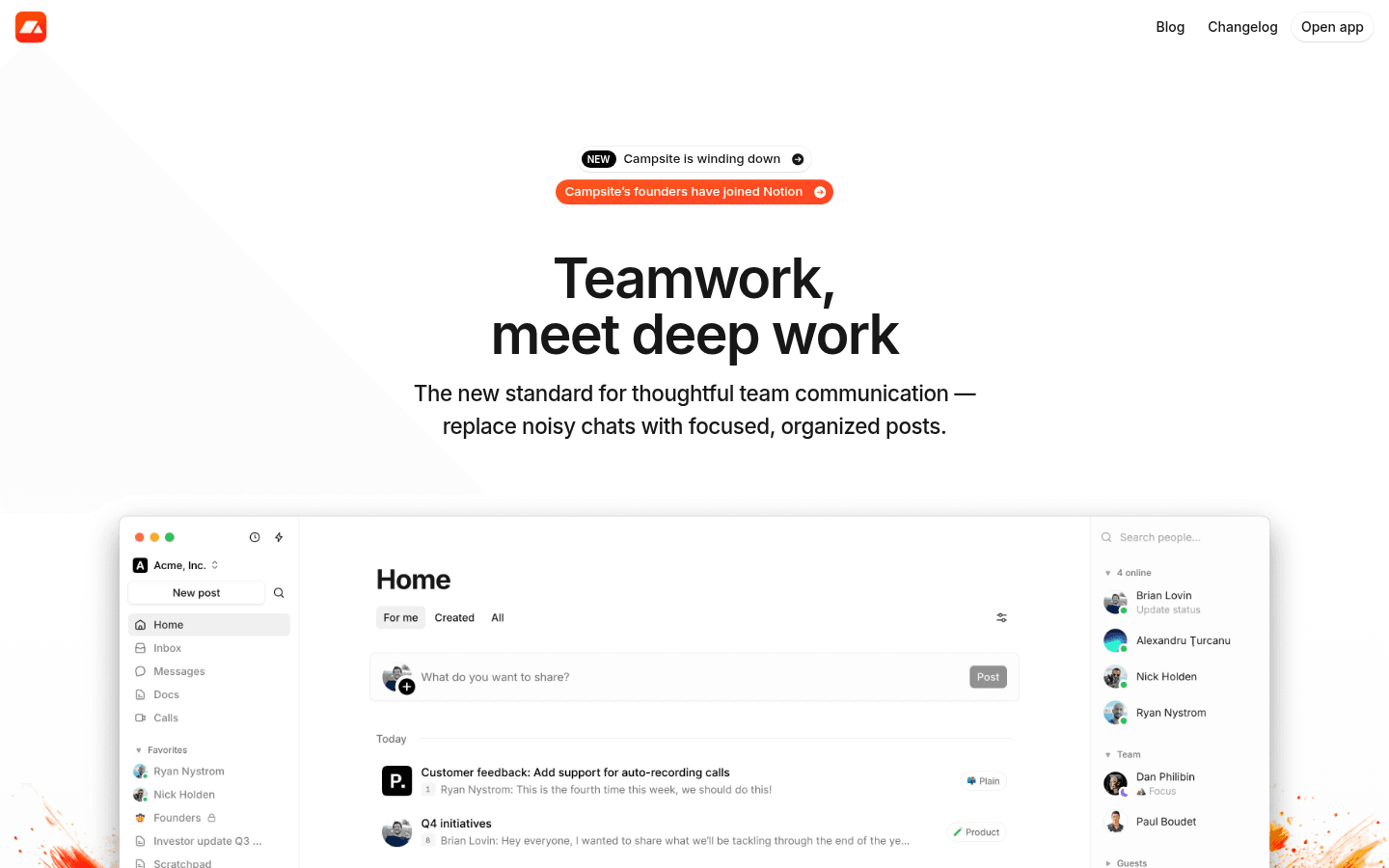
Source: campsite.com — first-screen capture as of Oct 2026 (product wound down Feb 2025; site still shows wind-down / founders→Notion banners).
Lesson: Tasteful UX and a passionate niche aren’t a moat if the company becomes an acquihire-shaped ending. The hole in the market can reopen—competitors will pitch ex-Campsite users—but your context still has to move.
Threads.com (acquired by Shopify, 2024)
A Slack-alternative startup that shared an unfortunate name collision with Meta’s consumer Threads. TechCrunch reported Shopify acquired Threads.com in June 2024; the team framed joining Shopify as a chance to “tinker at scale,” amid domain/brand confusion pressures.
Lesson: Category products die from brand gravity and acquisition gravity as much as from bad software.
Quip (Salesforce → end of life path)
Quip—documents + discussion—is being retired from Salesforce’s portfolio, with guidance toward Slack / Agentforce-era workflows and Slack Canvas lineage (Salesforce Ben coverage of Salesforce’s EOL messaging; subscriptions not renewable after the announced date). Not pure “chat,” but a reminder that collab suites get absorbed into the winner’s OS.
Lesson: “Chat + docs in one place” can still lose to the default messenger + the default doc.
Honorable mentions
- App.net (social/microblogging platform era)—different category, same cautionary: protocol ambition without distribution.
- Countless IRC→Slack migrations—and Slack→Teams mandates—that weren’t product deaths so much as organizational regime change.
Recurring causes of death
1. The default always has a gravity well
Chat isn’t chosen once; it’s re-chosen every time you invite a contractor. Slack and Teams win on mutual knowledge. Alternatives must be 10× better for a sharp job—or free/self-hosted enough to ignore fashion.
2. Dual-home forever
If the product never becomes the destination—if it stays a prettier side channel—habit drains back to the default. Bridges without a cutover date are how zombies live.
3. Parent-company strategy risk
Workplace didn’t lose because groups were unusable. It lost because Meta’s capital and attention moved. Buyers of venture-backed chat should ask: what happens if the story changes?
4. Acquihire shaped like a product dream
Campsite’s ending is gentle and still terminal for the product. Evaluate not only roadmap—but whether the company can remain independent long enough for your migration to pay off.
5. Wrong war
Competing with Slack on emoji density and channel UI is a war of attrition. Competing on a new coordination problem (for 2026: humans + agents) is a different bet—still risky, but not the same grave.
Why agent-native might be different (careful optimism)
Ando’s founding story isn’t “calmer Slack.” It’s that agents were treated as apps while becoming participants, and that meat proxies waste human attention (Introducing Ando, TechCrunch Sep 2026).
Reasons this could escape the classic graveyard—none guaranteed:
- New job-to-be-done. Not slightly nicer human chat—shared rooms for humans and agents.
- Incumbents are adding AI, not rewriting membership. Slack AI is real; agent-as-member messaging is still a different architecture bet.
- Small-team wedge. Ando starts ~2–40 humans—where tool switches are possible (ando.so).
- Bridge without pretending to be a wrapper. Sync + Bridge while refusing “Slack skin forever” (FAQ).
Reasons it could still die like the others:
- Defaults remain defaults.
- Orchestration platforms may siphon “agent” budget while chat stays put.
- Early products feel janky before the agent magic shows (Du has said early demos felt like a jankier messenger—TechCrunch).
- Any startup can be absorbed.
Humility is part of the brand. The graveyard is full of confident roadmaps.
Buyer checklist (steal this)
Before you migrate a team off Slack/Teams to anything:
- [ ] Is this a messaging destination or an orchestration tool with chat cosplay?
- [ ] What’s the cutover ritual (not eternal dual-home)?
- [ ] What history actually imports—and what doesn’t?
- [ ] If the vendor is acquired tomorrow, can you export?
- [ ] Are you buying because of agents-as-teammates—or because you’re mad at Slack pricing this month?
FAQ
Did Meta replace Workplace with Slack? No for customers (Workvivo was the preferred partner). Meta later moved some internal chat to Slack for agent reasons—separate story.
Is Campsite inside Notion now? Founders joined Notion; the Campsite product wound down. Don’t assume feature parity landed intact.
Should I avoid all Slack alternatives? No—go in clear-eyed. Prefer sharp wedges, honest stage, and export paths.